Discover HKBU
IWW award-winning novelist reflects on family ties
31 Oct 2025

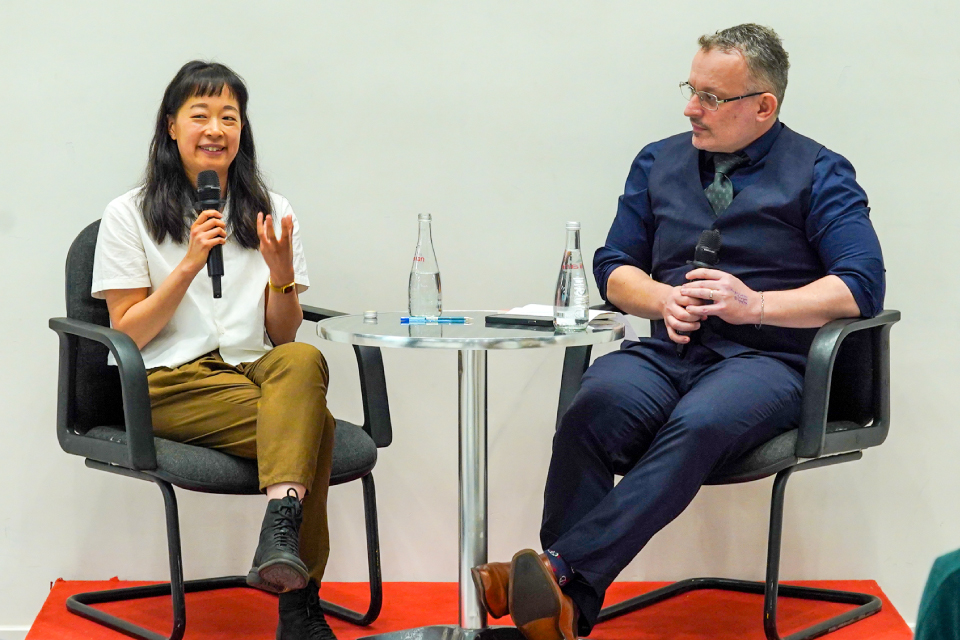
At the annual International Writers' Workshop (IWW) hosted by HKBU on 22 October, Melbourne-based writer Jessica Au engaged participants in a heartfelt discussion about her latest novel, Cold Enough for Snow, which explores themes of family, memories and cultural identity. Ms Au’s lyrical prose in Cold Enough for Snow stood out from 1,500 entries, making it the inaugural winner of The Novel Prize, a new biennial award established by Giramondo, Fitzcarraldo Editions and New Directions. The novel has now been translated into 19 languages.
On behalf of HKBU, Professor Daisy Tam, Associate Dean (Development) of the Faculty of Arts and Social Sciences, welcomed guests from the Australian Consulate-General, HKBU students, secondary school students and members from the public to the full house event. Ms Au then delivered a 20-minute reading from her book, and shared about her work with Professor Patrick Holland, Assistant Professor, Academy of Language and Culture at HKBU.
Central to the novel are family ties and the ways in which those who love each other can still struggle to communicate, ultimately drifting apart, as seen in the relationship between the protagonist and her mother. “The mother and daughter share many polite conversations, but both sense the tension in the air. There is an expectation that parents and children, especially mothers and daughters, maintain a close connection. Yet as people age and their life paths diverge, a subtle distance often creeps in,” Ms Au observes.
The setting in Japan is also a deliberate choice, to highlight the role reversal between mother and daughter, with the daughter, who is familiar with the country, directing their entire trip. These nuanced dynamics and a sense of nostalgia run through the novel, inviting readers to reflect on their own familial obligations.
Cold Enough for Snow concludes with a rather enigmatic ending, as some readers have observed. Ms Au acknowledges this observation, admitting she wants to infuse her work with a folktale-like quality and an element of mystery. She states, “One of the things literature does well, is letting us know things don’t always need certainty. It allows for ambiguity, conflicting feelings, and a tolerance for complexity, which is vital in understanding our shared human experiences.”