Discover HKBU
“Warscape from Above”: Kowloon revealed through an unseen lens
31 Oct 2025
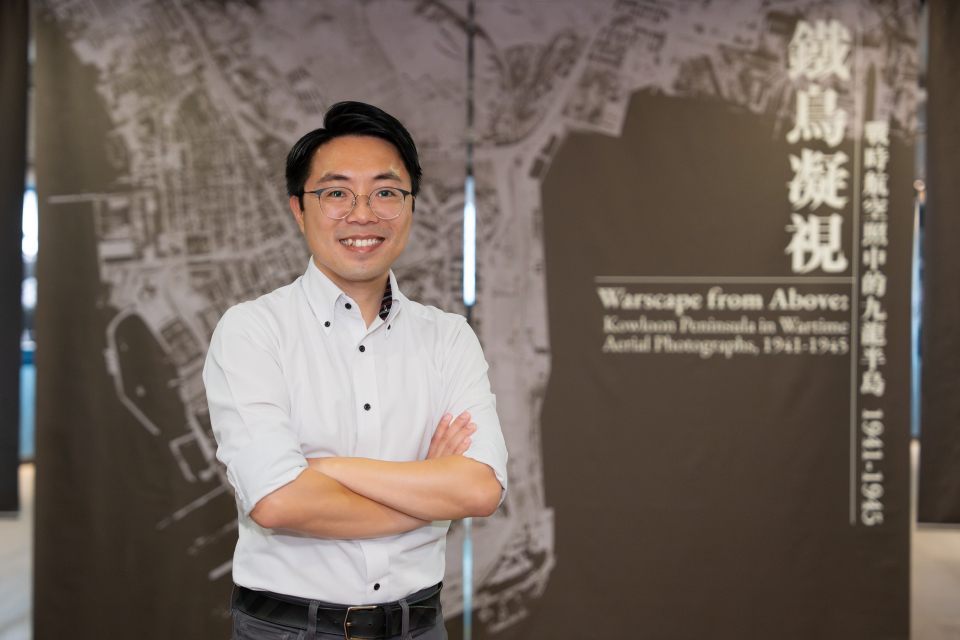
Serendipity is probably not the first word that comes to mind to describe "Warscape from Above: Kowloon Peninsula in Wartime Aerial Photographs”, a visually stunning exhibition curated by Professor Kwong Chi-man, Chair of the Department of History at HKBU and the Principal Investigator of the Hong Kong Spatial History Project, the organiser of the exhibition.
When visitors step into the exhibition at Jao Tsung-I Academy, they are greeted by a sprawling display of over 100 wartime aerial photos, revealed for the first time in 80 years. Captured by the Allied Forces over Sham Shui Po, Kowloon City, and Yau Tsim Mong during the Japanese occupation from 1941 to 1945, these photos raise an intriguing question: How did they find their way to the University?
“Back in 2023, I participated in a talk by an American scholar on North Korea’s historical architecture and aerial photography. He guided me in my search for these aerial photos, and we discovered a large number of aerial images of Hong Kong taken by the Allies during World War II. These photos were taken to survey the terrain before the airstrikes and to confirm whether the targets were hit afterwards. They document the city's destruction, reconstruction, and resilience over those years, serving as concrete examples of historical preservation,” says Professor Kwong. As the saying goes, the rest is history, culminating in the awe-inspiring curation of “Warscape from Above”.


Honouring the past
The photos from the exhibition reveal invaluable details about Kowloon’s pre-war landscapes, including historical buildings such as the original Kai Tak Airport, the Yau Ma Tei Theatre which survived an air raid in 1943 leaving one wall intact, and the Stonehouses Family Garden on Junction Road in Kowloon City, which has been revitalised and now houses a social enterprise café.
“A large amount of information was lost and many buildings were destroyed during World War II. The aerial photos taken by the Allied forces provide a comprehensive record of different districts during the Japanese occupation, serving as an invaluable resource for studying Hong Kong’s wartime history, remnants of war, regional development, and historic buildings. These photos are also highly valuable for supporting related conservation efforts,” Professor Kwong highlights.
The exhibition goes beyond photographs; it also features around 15-cubic-centimetre 3D models of iconic historic buildings, such as Heep Yunn School, 190-204 Prince Edward Road West, Yee Kuk Street in Sham Shui Po, Lui Seng Chun, and the Nam Cheong Pawn Shop. These models were produced by the Hong Kong Spatial History Project team in collaboration with partners including HKBU Art Tech Incubation Hub CHRYSALIS.


Preserving wartime narratives
While serendipity may have played a part in bringing these aerial photographs to light, the exhibition also stands as a testament to the passion and hard work of the team behind the Hong Kong Historical Spatial Data Platform research project. By showcasing the resilience a city in times of adversity, “Warscape from Above” fulfills a mission shared by historians worldwide, that is to preserve the narratives of wartime survivors - people and places alike.
HKBU’s Hong Kong Spatial History Project has been awarded HK$5.2 million from the Research Impact Fund 2024/25 of the Research Grants Council. The research team utilises geographic information technology and artificial intelligence to build a data platform covering Hong Kong’s history from the 18th to 20th centuries, which will be freely available for use by researchers, educators, urban planners, conservationists, the tourism sector, and the general public.
Funded by Built Heritage Conservation Fund, “Warscape from Above” is open to the public and runs until 10 December at Jao Tsung-I Academy in Sham Shui Po, CLP Pulse in Kowloon City and the ground floor of Kwong Wah Hospital in Yau Ma Tei.